When Systems Decide First
A citizen’s executive brief on the forces reshaping elections, identity, and public oversight

This piece is a companion to a longer essay1 that examined how power is increasingly exercised through systems that go live before public understanding has time to form. What follows is not a simplification of that argument, but a translation of it—an executive brief written for citizens rather than institutions. In a moment when decisions are being operationalized faster than they are debated, democratic resilience depends on ordinary people having access to the same kind of clear, structural orientation that executives and policymakers rely on. This brief is offered in that spirit: not to tell readers what to think, but to make it easier to see what is already happening.
Think of this as a map of the terrain—not a set of marching orders—so that what already surrounds us is easier to recognize.2
When Systems Decide First
A citizen’s executive brief on the forces reshaping elections, identity, and public oversight
Robert J. Rei, January 30, 2026
When Systems Decide Before We Do
Why disappearing links, blocked tools, and “secure elections” are part of the same story3
Something important is happening, and most people are only seeing pieces of it.
A link to an official government document disappears after being posted.
An app that helps people understand what the government is doing gets pulled from an app store.
A website launches that asks families for Social Security numbers and citizenship details, but few people remember hearing about it being debated.
Each of these things, on its own, can sound small. Together, they point to a bigger shift in how power works today.
This is not mainly about censorship.
It is not mostly about free speech.
And it is not just about politics.
It is about how decisions are being made before most people realize there is a decision to be made at all.
From debate to “it’s already live”
For most of American history, big civic changes followed a rough order:
First there was debate.
Then laws were passed.
Then systems were built to carry those laws out.
That order is starting to flip.
Now, systems are often built and turned on first. Public understanding comes later. Sometimes much later.
A good example is TrumpAccounts.gov, a federal website that already exists and already works. It invites families to enroll children in a savings program tied to identity information like Social Security numbers and citizenship status. Whether someone likes or dislikes the idea is not the point here.
The point is this:
Most people encountered the system before they encountered the discussion.
The website itself became the argument.
Once a system is live, it feels normal. It feels official. It feels settled. And that makes it much harder to step back and ask basic questions like:
Why is this designed this way?
Who does it include?
Who does it leave out?
What happens to the data later?
Why some links vanish and others stay
Now return to the disappearing link.
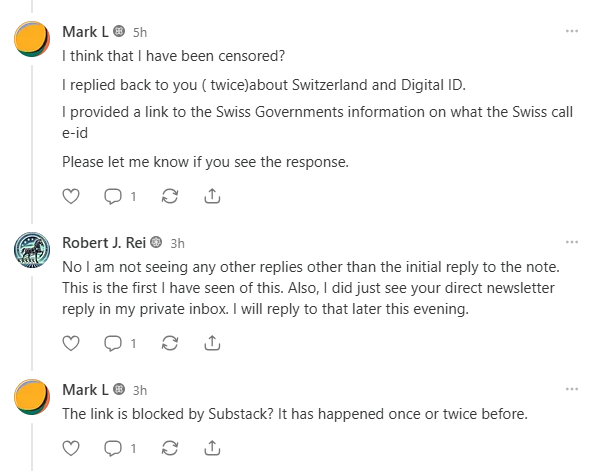
In a Substack thread, a reader tried to post a link to a specific Swiss government law about digital identity. The link vanished after posting. A different link—one that explained the same system in general terms—stayed.4
That difference matters.
The first link pointed directly to a law tied to a vote.
The second pointed to a plain-language explanation page.
Both were official. Both were accurate. Only one stayed.
This tells us something important:
Platforms are increasingly more comfortable with explanations than with primary civic documents, especially when those documents relate to elections, identity, or eligibility.
Not because the documents are wrong.
But because they carry authority.
Primary documents let people draw their own conclusions. Explanations guide people toward pre-packaged understanding.
The SAVE system problem, explained simply
This same pattern shows up in the debate over voter eligibility systems like SAVE.
SAVE began as a way to verify whether non-citizens qualified for certain benefits. Over time, it has been expanded and adapted so that it can now be used to check citizens, including people born in the United States.
That shift happened through system upgrades and administrative changes—not through a nationwide conversation with voters.
Even the name shows the mismatch. SAVE stands for Systematic Alien Verification for Entitlements. Yet it is now used in ways that treat citizenship as something that must be continually proven, rather than something presumed.
This is not about accusing anyone of bad intentions. It is about noticing what happens when systems designed for one purpose quietly take on another.
Once the system exists, the question changes from “Should we do this?” to “How do we manage it?”
Why tech platforms are part of this, even if they did not start it
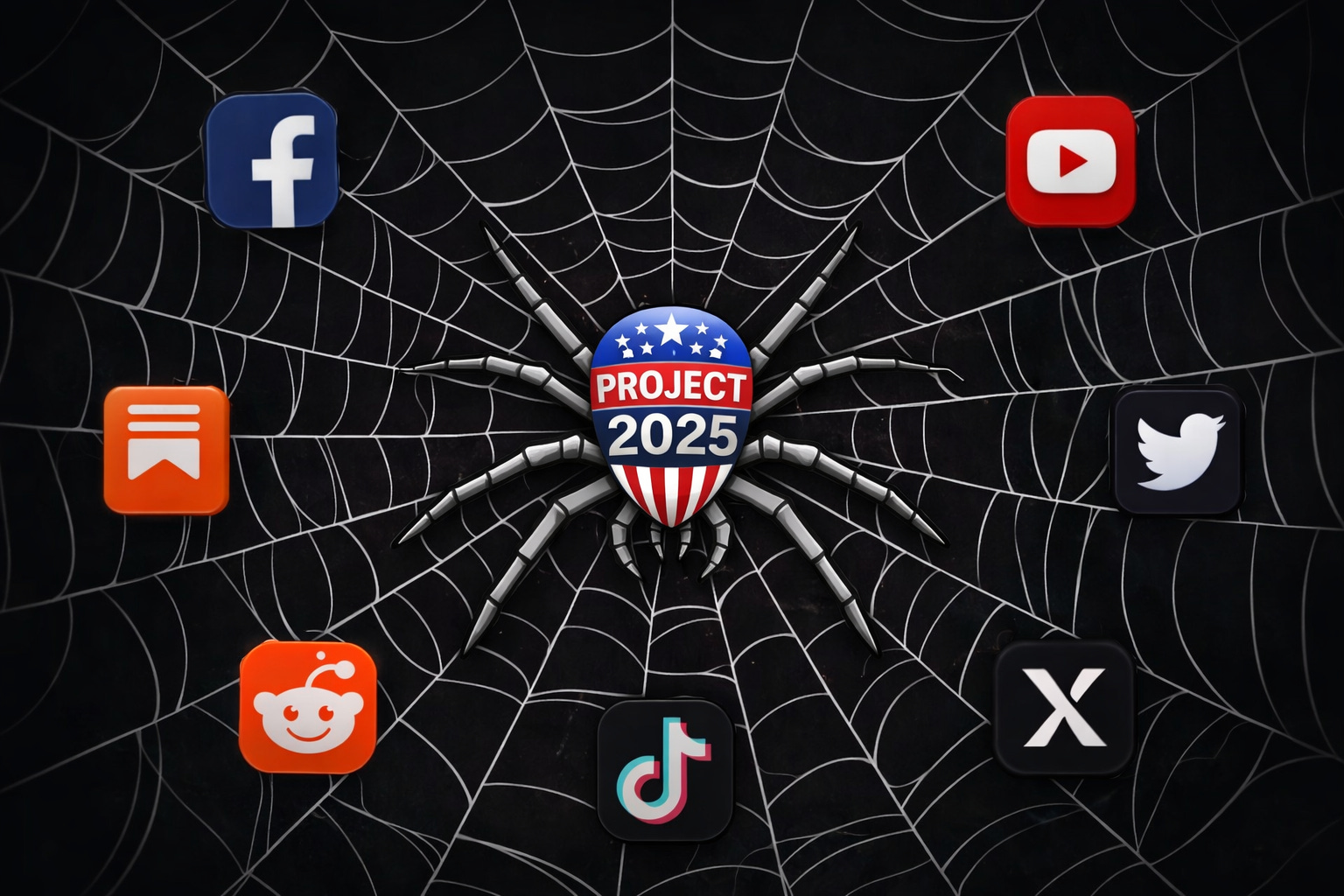
Tech platforms did not invent this shift. But they now help manage it.
When a system is already running, platforms are left to decide:
Which links are safe to circulate
Which tools can be downloaded
Which references need extra “context”
Which replies quietly never appear at all
That is not old-fashioned censorship. It is traffic control for authority.
And it shapes what people are able to see, share, and question—often without anyone announcing that a decision was made.
The real issue: timing and visibility
The core issue is timing.
When systems go live before public understanding forms, accountability becomes harder. Oversight turns into cleanup. Debate turns into damage control.
Democracy depends on people being able to see how power is exercised before it becomes routine.
That is why disappearing links matter.
That is why blocked tools matter.
That is why identity systems deserve attention before they feel normal.
None of this requires panic. But it does require attention.
Because once systems are fully in place, the hardest question to ask becomes the simplest one:
Who decided this—and when?
With vigilance,
A citizen who refuses silence.
Robert J. Rei, January 30, 2026
How election integrity and digital identity became infrastructural facts

“We want every eligible American to vote… but we want honest elections. We want secure elections.”
For a detailed, documented analysis of how identity verification, eligibility systems, and administrative infrastructure have been constructed and expanded prior to public debate, see Timothy C. Tucker, The Department of Governance by Algorithm: How DOGE Built Cleta Mitchell’s Dream Machine, Part V of the Warrantless Surveillance Series.

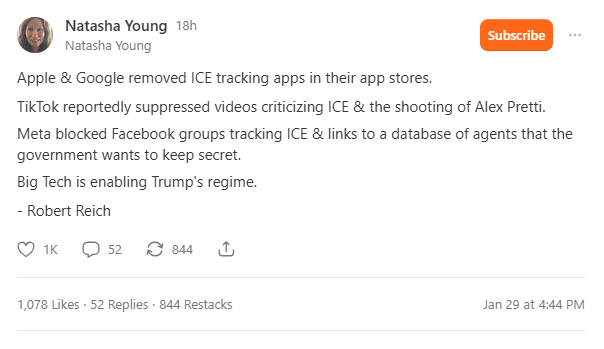
Apple & Google removed ICE tracking apps in their app stores.
TikTok reportedly suppressed videos criticizing ICE & the shooting of Alex Pretti.
Meta blocked Facebook groups tracking ICE & links to a database of agents that the government wants to keep secret.
Big Tech is enabling Trump’s regime.
- Robert Reich
I think that I have been censored?
I replied back to you ( twice)about Switzerland and Digital ID.
I provided a link to the Swiss Governments information on what the Swiss call e-id
Please let me know if you see the response. [Mark L]