How election integrity and digital identity became infrastructural facts
What identity systems and disappearing documents reveal about power today

“We want every eligible American to vote… but we want honest elections. We want secure elections.”
— Donald J. Trump

How election integrity and digital identity became infrastructural facts
What identity systems and disappearing documents reveal about power today
Robert J. Rei, January 29, 2026
When Links Disappear
Control of Reference Authority in the Platform Age
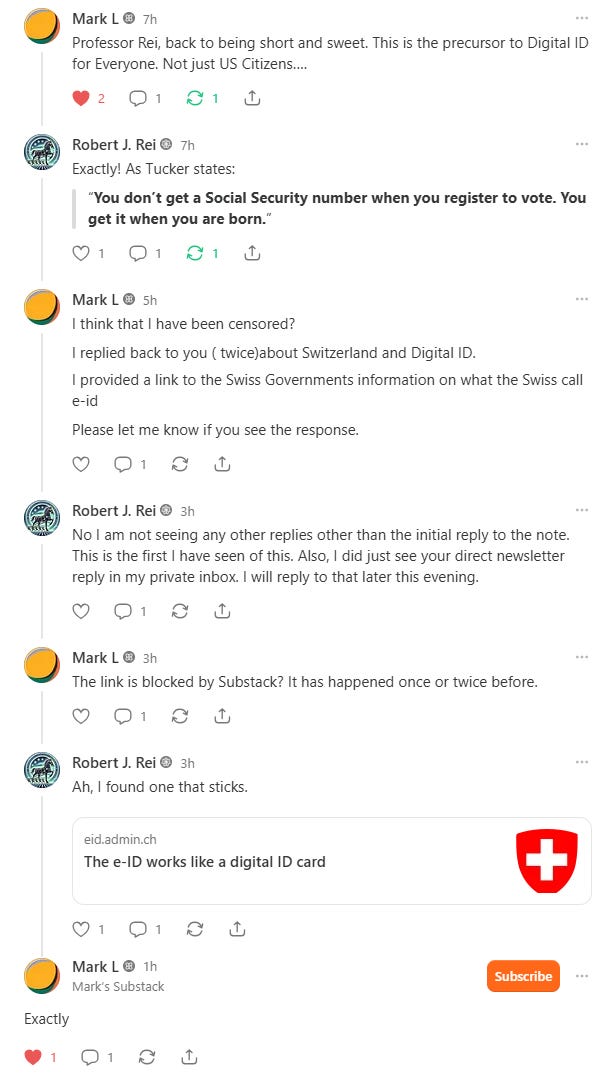
A small but revealing event occurred recently inside a Substack note thread.1 A reader attempted to reply with a link to official Swiss government documentation explaining that country’s electronic identity law. The reply posted successfully—but the link itself vanished within seconds, leaving the explanatory text intact and the reference gone. No warning. No notice. No explanation.
Moments later, a different link—pointing not to the legislative document itself but to a higher-level Swiss government portal describing the same electronic identity system—was posted. That link rendered normally, remained stable, and even generated a preview card.
The screenshot accompanying this essay documents the sequence clearly: one official source quietly removed, another allowed, both addressing the same subject matter.
This was not a moderation dispute, nor a case of improper behavior. It was something more structural—and more instructive.
The difference between the two links was not ideological or factual. It was architectural. One pointed to a deep, authoritative civic document: a specific act, tied to a vote, anchored to a date, housed in a public archive. The other pointed to a public-facing explanatory portal: general, contextual, designed for onboarding rather than proof.
Both were accurate. Both were official. Only one was permitted.
This reveals an increasingly common platform logic: when a link could be interpreted as election-related or civically authoritative material circulating without context, the system defaults not to debate or disclaimer, but to redirection. Authority is not denied. It is rerouted.
At first glance, this appears to be a story about platforms—how they manage risk, liability, and amplification in an era of accelerated civic conflict. But that framing is no longer sufficient. What the vanishing link ultimately points to is not just platform behavior, but a deeper transformation in how authority now enters public life.
Authority increasingly arrives not as argument, law, or documentation, but as infrastructure—as live systems that present themselves directly to citizens, already operational, already normalized, and already framed as administrative fact.
It is in this context that systems like TrumpAccounts.gov become relevant. The site is not hypothetical. It is a functioning federal portal that solicits identity, citizenship status, and financial behavior as part of a new savings program for children born within a specific four-year window. It arrives not through sustained public debate, but through interface. Its legitimacy is asserted through operation rather than explanation.
Once authority presents itself this way, platforms inherit a secondary role: managing references to systems that are already running. The question shifts from whether such systems should exist to how they should be understood—often after adoption has already begun.
This is the turn the essay now makes.
The Turn: Platforms Are No Longer the First Gate
At this point, the familiar story about platforms quietly managing what can circulate begins to break down—not because it is wrong, but because it is no longer sufficient.
The disappearing Swiss link illustrates how platforms act as downstream governors of reference authority. But that role increasingly occurs after something more consequential has already happened. In a growing number of cases, the public does not first encounter authority through debate, reporting, or documentation filtered by platforms. Instead, authority now arrives pre-packaged—as a functioning system, already branded, already operational, already framed as normal.
In other words, platforms are no longer always the first gate. They are often the second.
The sequence has inverted. Rather than public deliberation producing policy, and platforms mediating the resulting discourse, systems are now built and presented directly to citizens as administrative facts. Only afterward do platforms encounter the problem of how to manage references to them—how to route links, how to surface explanations, how to avoid amplifying materials that feel “authoritative” before context has been widely established.
This inversion matters. When a system is encountered first as infrastructure rather than as an argument, the question is no longer whether it should exist, but how it should be understood. Reference authority is no longer something debated in advance; it becomes something explained retroactively.
The result is a subtle but decisive shift in civic experience. Citizens do not meet power at the level of law or policy. They meet it at the level of interface.
TrumpAccounts.gov and the Direct Presentation of Authority
It is against this backdrop that TrumpAccounts.gov becomes relevant—not as an aside, and not as a partisan curiosity, but as a live example of reference authority being instantiated directly, before broad public understanding has formed.
TrumpAccounts.gov is a federal .gov website presenting a statutorily authorized savings program for children. It is not speculative. It is a functioning public-facing system that asks families to engage, enroll, and provide information. It integrates identity, citizenship status, and financial behavior into a single administrative workflow. It is branded, explicitly and unmistakably, to a living political actor.
What matters here is not whether the underlying statute exists—it does. What matters is how authority is being presented.
The site does not arrive framed by public debate or legislative pedagogy. It arrives as an interface. A portal. A ready-made reference point that asserts legitimacy through design, domain, and operational presence rather than through argument. Its authority is not primarily discursive. It is infrastructural.
This is precisely the condition under which reference authority becomes difficult to contest. When a system is live, branded, and operational, the burden shifts. Questions of fairness, scope, data governance, and long-term consequence are no longer preconditions. They become follow-up concerns—often deferred, often fragmented, often routed through secondary explanations rather than primary materials.
TrumpAccounts.gov is also notable for the kind of engagement it solicits. Participation requires the provision of highly stable identity primitives: Social Security numbers, birthdates, citizenship status, guardian relationships, and ongoing financial contributions. These are not incidental attributes. They are the core inputs of modern identity-resolution systems. Once gathered, they do not simply vanish; they persist, update, and interoperate across administrative domains.
None of this requires malicious intent to be consequential. A system does not need to be designed as surveillance to become structurally surveillant. Scale, persistence, and integration are enough.
What makes TrumpAccounts.gov particularly instructive is that it demonstrates how authority now bypasses the traditional sequence of civic legitimacy. Rather than law producing understanding which produces adoption, adoption is invited first, and understanding is expected to follow. Platforms then find themselves in a secondary position—deciding how to manage links, explanations, and references to a system that is already running.
Seen this way, TrumpAccounts.gov is not an anomaly. It is a case study in how modern governance increasingly operates: by presenting finished systems as faits accomplis, and allowing the reference layer to catch up later, if at all.
The SAVE System as Structural Confirmation, Not Speculation
If TrumpAccounts.gov demonstrates how authority can now be presented directly to citizens as infrastructure, the SAVE system—documented in detail by Timothy C. Tucker—demonstrates what happens when that mode of presentation migrates into the core of civic eligibility itself.
The importance of Tucker’s analysis does not rest on any single allegation or actor. It rests on sequencing.
The SAVE system did not emerge from a public mandate to redesign voter verification. It evolved through administrative integration. What began as a narrow, case-by-case immigration eligibility check was re-engineered into a bulk identity-resolution pipeline capable of ingesting entire voter rolls, matching them against cached federal datasets, and outputting determinations at scale. This transformation occurred before Congress meaningfully debated the SAVE Act as a matter of public policy, and largely outside the awareness of the electorate that would be affected by it.
That order matters.
The system was not built to answer a question that citizens had asked. It was built to satisfy an administrative appetite for efficiency, then introduced to select external stakeholders, then normalized through use. Legislative debate followed not as authorization but as backfill—an attempt to reconcile public process with infrastructure already in motion.
The name of the system itself warrants attention. SAVE stands for Systematic Alien Verification for Entitlements—language originally designed to verify the eligibility of non-citizens interacting with immigration and benefits systems. Yet the system’s expansion explicitly brings U.S.-born citizens into scope, including individuals who have never had any prior interaction with immigration authorities. The persistence of the word alien inside a system now positioned to evaluate the citizenship status of Americans by birth is not a semantic footnote. It is a residue of institutional origin that no longer matches operational reality.
When a system built to verify the status of “aliens” becomes an engine for screening citizens, the shift is not merely technical. It marks a conceptual inversion: citizenship itself is treated as a conditional attribute to be re-verified, rather than a foundational status presumed by default.
This inversion helps explain why the naming collision between the SAVE system and the SAVE Act is more than coincidence. The legislative proposal and the administrative infrastructure now share not only an acronym, but a governing assumption: that eligibility for participation in civic life must be continuously demonstrated through documentation, databases, and automated checks. Whether enacted through statute or implemented through system design, the result is the same. The burden quietly migrates from the state to the individual, and from law to workflow.
Placed alongside TrumpAccounts.gov, the connective tissue becomes visible. Different domains—financial savings for children, voter eligibility verification—but the same structural logic: build first, integrate second, explain later. Authority is asserted not through argument, but through functioning systems that invite compliance before comprehension.
The relevance to the opening vignette should now be clear. When platforms quietly redirect links away from primary civic documents and toward explanatory portals, they are not creating this condition. They are responding to it. They are managing the circulation of reference authority in an environment where authority increasingly arrives pre-assembled, already running, and resistant to reversal.
This is not a conspiracy of actors. It is a convergence of methods.
Convergence Without Conspiracy
At this stage, a clarification is necessary—not to weaken the argument, but to protect its accuracy.
Nothing described here requires secret coordination, shared intent, or centralized direction. Structural alignment is sufficient.
When administrative systems are designed around the same primitives—identity resolution, scale, automation, persistence—their behaviors converge even when their mandates differ. A voter-verification engine and a child savings program may appear unrelated at the policy level, yet still rely on the same underlying logic: stable identifiers, interoperable datasets, and workflows that convert administrative outputs into real-world consequences.
This is how governance changes without announcing itself.
The mistake is to look for motive where method is doing the work. Once systems privilege efficiency, bulk processing, and automated determination, they begin to resemble one another regardless of purpose. Legitimacy becomes a property of operational status rather than democratic assent. What matters is not whether a system is controversial, but whether it is already running.
This is why the emphasis throughout this essay has been on sequencing rather than accusation. When infrastructure precedes understanding, critique arrives late and fragmented. Questions that would have been decisive at the design stage—scope, fairness, error tolerance, data persistence—are reframed as implementation details. Contestation becomes remediation.
In that environment, the reference layer takes on outsized importance. If primary documents are difficult to circulate, if authoritative materials are routed through portals rather than accessed directly, the ability to interrogate systems at their foundation erodes. Citizens are left responding to explanations rather than examining structures.
The danger here is not hidden intent. It is momentum.
Systems that function acquire defenders by virtue of functioning. Reversal becomes costly. Alternatives are labeled impractical. And because these systems often present themselves as neutral tools rather than political choices, resistance is mischaracterized as obstruction rather than participation.
Seen this way, the platform behavior that opened this essay is not incidental. It is part of the same adaptive environment. Platforms are not inventing these dynamics; they are adjusting to them—attempting to manage the circulation of authority in a landscape where authority increasingly bypasses discourse altogether.
Conclusion: Reference Authority as the Integrity Question
The question raised by a disappearing link is therefore larger than it first appears.
It is not simply about moderation practices, or even about platforms. It is about where authority is allowed to live in a system increasingly governed by infrastructure. When citizens encounter law through interfaces rather than texts, through portals rather than statutes, and through outcomes rather than debate, legitimacy quietly migrates from public process to operational fact.
Election integrity, digital identity, and civic trust are often discussed as separate issues. They are not. They are facets of the same transformation: the relocation of governance from deliberation to workflow, from argument to execution, from law to system.
In that context, control of the reference layer becomes decisive. Which documents circulate freely, which are abstracted into summaries, and which are quietly redirected determines not just what people know, but how they are permitted to know it. Authority is not denied; it is mediated—sometimes to the point of invisibility.
What follows is not interpretive commentary, but a documented account of how identity-verification infrastructure is being built, accessed, and normalized in practice.
Because questions of integrity increasingly hinge on who controls primary reference material, the source documentation itself is worth reading in full.

Editor’s Note: Why This Matters Now
This essay arrives at a moment when debates over the SAVE Act are resurfacing in Congress, even as the administrative SAVE system it references is already operational, expanded, and embedded. At the same time, TrumpAccounts.gov has quietly gone live as a public-facing federal portal, inviting families to participate in a new identity-linked financial program before most Americans have had time to understand its scope or implications.
These developments are not isolated. They reflect a broader shift in how authority is exercised and encountered: through systems first, explanation later. As election-integrity discussions intensify and digital identity becomes a governing substrate rather than a policy topic, understanding how reference authority itself is being managed is no longer an abstract concern. It is a prerequisite for meaningful civic participation.
This piece is offered not as advocacy, but as orientation—so readers can see the infrastructure that is already running beneath the debates now unfolding.
With vigilance,
A citizen who refuses silence.
Robert J. Rei, January 29, 2026
References:
TrumpAccounts.gov (Official Program Portal) – the source site itself, describing the Trump Accounts program and eligibility. Trump Accounts – Official Federal Portal
U.S. White House overview – official explanation of eligibility and projected impact under the Working Families Tax Cuts Act. Trump Accounts Give the Next Generation a Jump Start on Saving (WhiteHouse.gov)
Internal Revenue Service guidance – IRS description of Trump Accounts, eligibility, and how the accounts are established (with reference to Form 4547). IRS Overview: Trump Accounts and Guidance
IRS Notice on Trump Accounts – technical IRS notice explaining structural and legal aspects of Trump Accounts under the Working Families Tax Cuts Act. Treasury/IRS Guidance on Trump Accounts (IRS Notice 2025‑68)
The following screen shot is an exchange within a larger note and is provided for context as the genesis of this essay: