
Why 3.5% Means Something Different Here
Hungary, the United States, and the real threshold of governability

“Power corresponds to the human ability
not just to act but to act in concert.”
—Hannah Arendt, On Violence
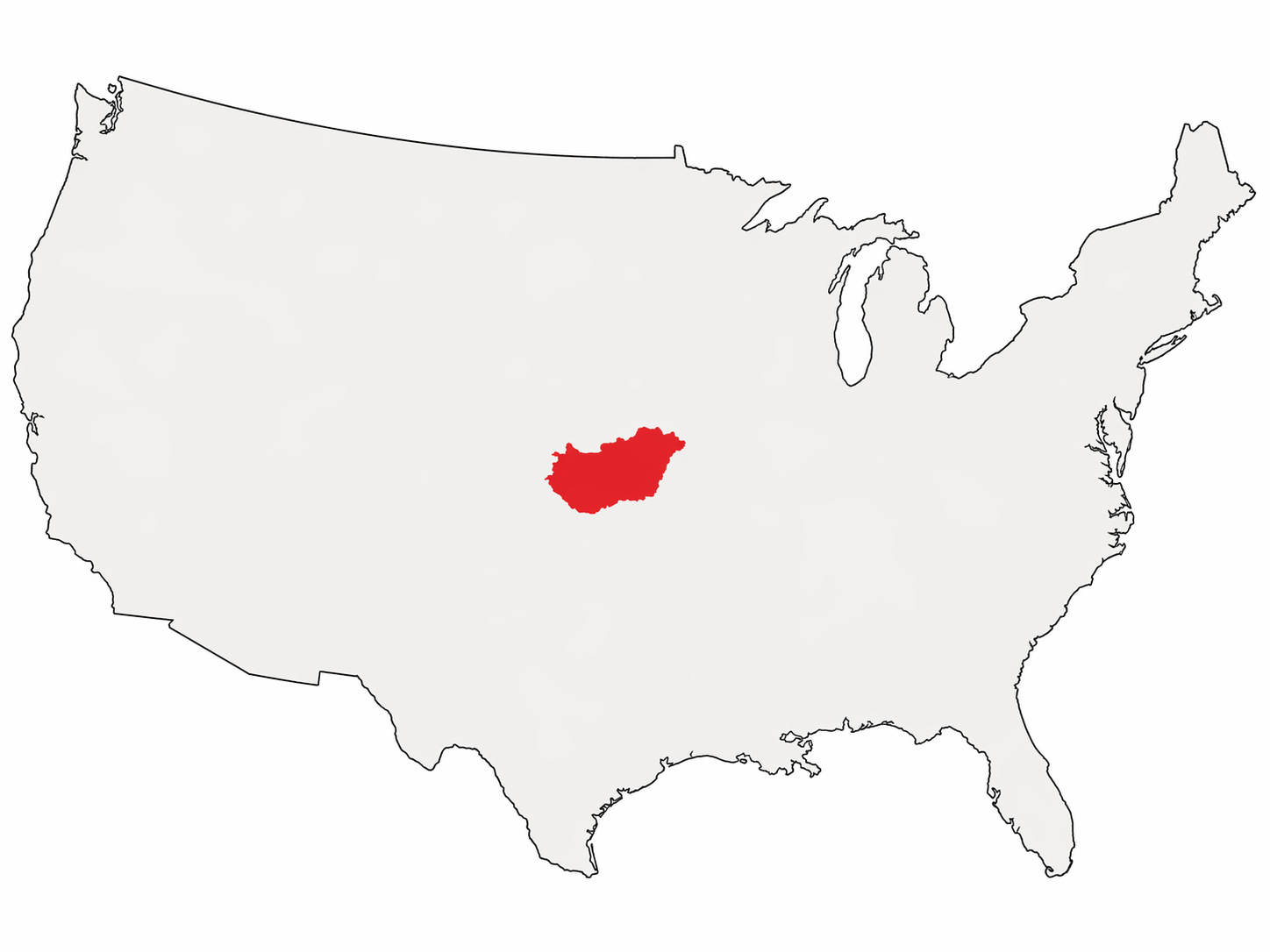
USA= 3,809,525 square miles; Hungary= 93,030 square kilometers
Why 3.5% Means Something Different Here
Hungary, the United States, and the real threshold of governability
Robert J. Rei, April 22, 2026
One of the most repeated ideas in protest discourse is the so-called 3.5% rule1: the belief that once roughly 3.5% of a country’s population is mobilized, the government begins to lose its grip. The phrase survives because it contains a real intuition, but it is often used too casually. Erica Chenoweth’s own later clarification is more careful than the slogan. The number emerged from observed patterns in nonviolent resistance campaigns; it was never meant to function as a mystical civic law. Chenoweth has explicitly warned that many successful movements did not reach 3.5%, and that the figure should be treated as a rough indicator, not a guaranteed trigger.
That correction matters because many people hear “3.5%” and imagine a clean mechanical threshold: hit the number, flip the government. Politics does not work that way. A movement does not become dangerous merely because many people are visible. It becomes dangerous when enough people are visible, organized, sustained, and socially distributed enough that ordinary cooperation begins to fail. The state’s real dependency is not applause. It is compliance. What threatens power is not only protest, but the erosion of the assumption that people, institutions, and territorial layers will keep carrying out normal routines on command. Chenoweth’s work points in that direction even when the public slogan flattens it.
This is where Hungary becomes useful, but only if it is used as a contrast scale rather than a template. According to World Bank data, Hungary’s 2024 population was about 9.56 million.2 By contrast, the U.S. Census population clock put the United States at about 342.45 million on April 20, 2026.34 The arithmetic alone changes the meaning of the slogan. Three and a half percent of Hungary is about 334,672 people. Three and a half percent of the United States is about 11,985,615 people. Those are not remotely similar civic undertakings. They share a percentage, but not a political reality.
Geography widens the gap further. The Census Bureau lists the United States at roughly 3,809,525 square miles in total area. World Bank data lists Hungary at 93,030 square kilometers of surface area. These are not just different states. They are different orders of political space. In a compact country, pressure can register as national much faster. In a continental federal republic, the same amount of energy can be intense in one region, thin in another, delayed in a third, and barely felt in a fourth. Americans often underestimate this because national media creates the illusion of one civic room. The United States is not one room.5 It is fifty state systems, layered jurisdictions, and multiple civic speeds moving at once.
Hungary’s recent political shift helps clarify the point. Reuters reported this month that Peter Magyar’s Tisza party ended Viktor Orbán’s sixteen-year rule in a landslide and, after the final count, secured 141 of 199 seats in parliament. Investors and business groups told Reuters6 they were looking for greater predictability, rule-of-law stability, and fewer abrupt legal changes after years of concentrated power and overnight policy shocks. That is important. Hungary did not illustrate a fairy tale in which an abstract number alone toppled a government. It illustrated something more realistic: legitimacy erosion, opposition consolidation, institutional fatigue, and a usable political channel finally converged.
That is exactly why Americans should be careful. Hungary can show what legitimacy loss looks like in a smaller polity. It cannot be imported whole into the United States. The American question is not, “Can 3.5% appear?” The American question is, “At what point does opposition become large enough, distributed enough, and institutionally embedded enough that federal escalation can no longer pass cleanly through the states?” That is a different question because the United States is governed through layers: federal command, state implementation, county and municipal cooperation, bureaucratic compliance, and public habit. National power in America does not move by proclamation alone. It moves by relay. When enough relays slow, skip, refuse, document, litigate, or distort transmission, power begins to drag.
This is where your earlier regime-structure argument7 becomes essential. Partisan color does matter, but it is not the decisive variable. The states that matter most under pressure are not merely the bluest or the reddest. They are the ones whose internal structure determines whether they function as brakes, buffers, or accelerators. A state with executive will, legal nerve, institutional professionalism, and independent local systems can force delay, documentation, scrutiny, and procedural drag. A state with ideological alignment, compliant administration, and weak internal checks can turn federal escalation into territorial reinforcement. That is why equal public anger produces unequal outcomes across the map. The issue is not only how many people oppose something. The issue is where they are situated, what institutions surround them, and whether dissent can be converted into administrative friction.
So when people say that a small percentage can “shut down” a country, the phrase needs translation. In a modern federal republic, protest alone rarely shuts anything down. What matters is noncooperation. Not only bodies in the street, but refusal inside the gears. Transport friction. Legal bottlenecks. Permit slowdowns. Labor disruptions. School-system resistance. Hospital nonalignment. Local documentation requirements. Attorneys general forcing process. Courts denying automatic glide paths. Journalists refusing normalization. Clergy and civic institutions legitimizing noncooperation instead of surrender. A government begins to lose smooth control when it can no longer assume that its directives will be carried forward as ordinary routine. That is what a real threshold looks like in the United States.
Trump complicates this further because the usual logic of cost deterrence cannot be assumed. A conventionally responsible executive, even an aggressive one, is at least somewhat constrained by the national expense of escalation. Trump has repeatedly shown a different governing style: he is willing to externalize cost broadly so long as the posture of dominance remains intact. Reuters recently summarized New York Fed findings showing that nearly 90% of the increased burden from his tariff policy was borne by U.S. firms and consumers, not by the foreign countries he claimed would pay. Reuters also reported that businesses were delaying pricing, hiring, and inventory decisions amid the resulting uncertainty. That does not prove indifference in some total psychological sense. It does support a civic inference: he does not govern like a steward whose first instinct is to minimize national drag. He governs like a political actor willing to let others absorb the expense.
That matters because it changes what opposition must do. If a leader is not reliably deterred by cost, then merely making escalation expensive may not be enough. The more serious objective is to make escalation hard to relay, hard to normalize, and hard to implement uniformly. That means the American version of the 3.5% idea is not simply mass turnout. It is mass turnout plus state structure plus institutional noncooperation. The real threshold is reached when enough people, in enough strategically structured states, make federal escalation administratively drag.
That is the proper lesson of the Hungary comparison. Hungary helps Americans see scale. It helps them realize that a percentage which sounds modest in the abstract can describe radically different civic masses in radically different political spaces. But the deeper American lesson is even more important. The United States will not be slowed, if it is slowed, by one elegant statistic or one cathartic weekend of protest. It will be slowed when enough citizens become clear enough, organized enough, and institutionally placed enough to turn dissent into friction across the states that matter now. In this country, the percentage matters less than the placement. And the placement matters less than whether dissent can interrupt the relay lines through which power becomes ordinary life.
The question is not whether enough Americans can be alarmed. The question is whether enough Americans, in the right places, can make escalation fail to travel cleanly through the republic.
In common cause,
Robert J. Rei, April 22, 2026
Additional selected source readings:
The 3.5% rule: Understanding what makes protest powerful,
https://www.hks.harvard.edu/faculty-research/policy-topics/advocacy-social-movements/35-rule-understanding-what-makes-protest
The ‘3.5% rule’: How a small minority can change the world, https://www.hks.harvard.edu/centers/carr/publications/35-rule-how-small-minority-can-change-world
Questions, Answers, and Some Cautionary Updates Regarding the 3.5% Rule,
https://www.hks.harvard.edu/centers/carr/publications/questions-answers-and-some-cautionary-updates-regarding-35-rule
Notes and Takeaways from The Success of Nonviolent Civil Resistance,
https://www.ricklindquist.com/notes/the-success-of-nonviolent-civil-resistance-by-erica-chenoweth
Questions, Answers, and Some Cautionary Updates Regarding the 3.5% Rule, Erica Chenoweth, Spring 2020, Issue 2020-005 Carr Center for Humans Rights Policy, Harvard Kennedy School, https://www.hks.harvard.edu/sites/default/files/2024-05/Erica%20Chenoweth_2020-005.pdf
Population, total - Hungary, World Bank Group, https://data.worldbank.org/indicator/SP.POP.TOTL?locations=HU
United States Census Profile, https://data.census.gov/profile/United_States
U.S. and World Population Clock, https://www.census.gov/popclock/
The Red-Future, the Blue-Future, and the Illusion of Duration

“Silence in the face of evil is itself evil. God will not hold us guiltless. Not to speak is to speak. Not to act is to act.”
US investors crave predictability after Orban’s overnight law changes,
Gergely Szakacs, April 22, 2026, Reuters, https://www.reuters.com/world/us-investors-crave-predictability-after-orbans-overnight-law-changes-2026-04-22/
The States That Matter Now

“The old believe everything; the middle-aged suspect everything; the young know everything.”
Thank You! This helps a lot! I'll have to reread several times to digest it all~