
The Visible State
Why anonymous public force is incompatible with democratic legitimacy

“This has had far-reaching consequences for their children, families, our communities, and the state of Massachusetts.”
—Governor Maura Healey1
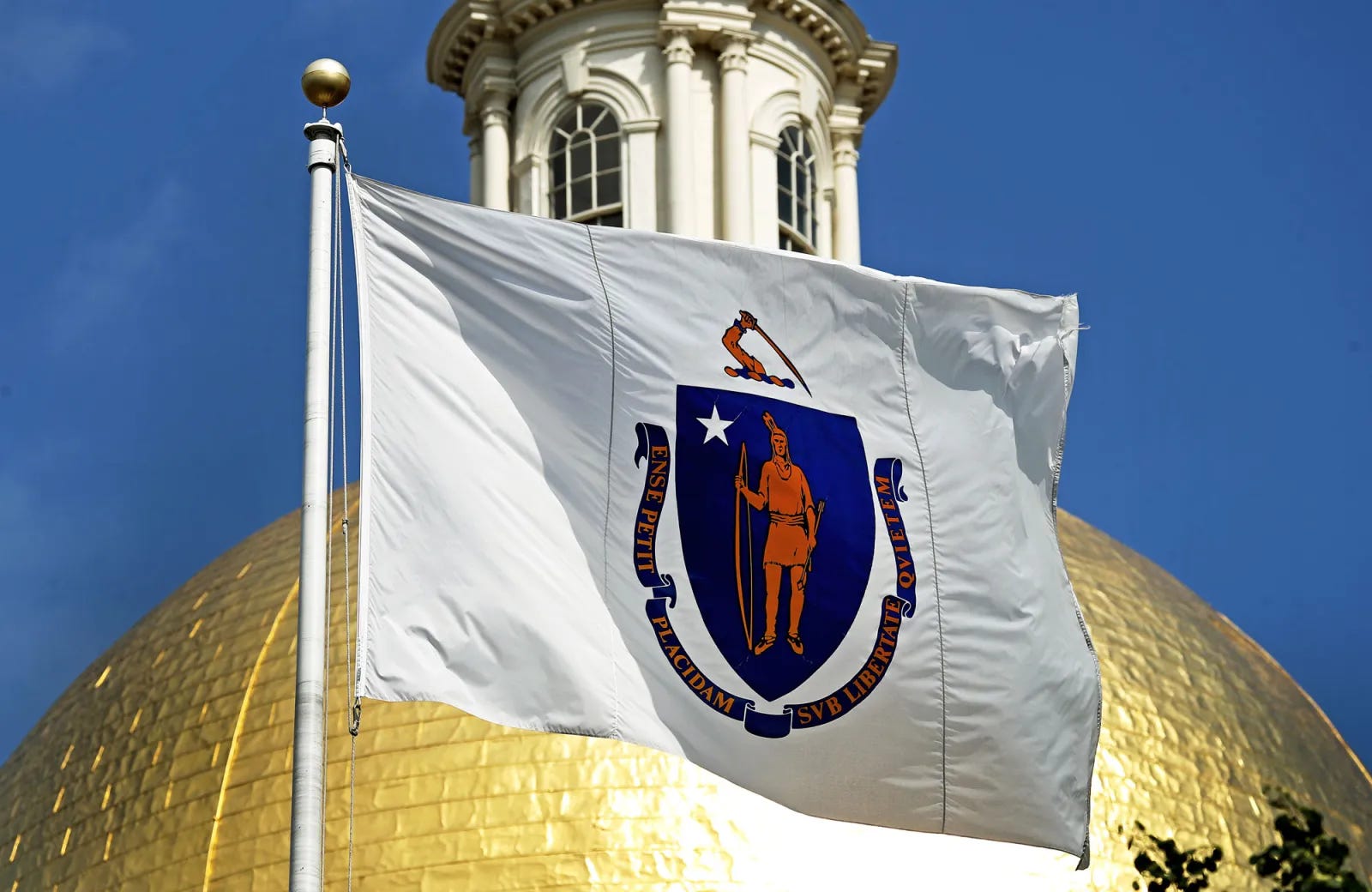
The Visible State
Why anonymous public force is incompatible with democratic legitimacy
Robert J. Rei, March 27, 2026
Massachusetts now has before it H.4684, An Act ensuring law enforcement identification and public trust. The bill would prohibit a law-enforcement officer from wearing “any mask or personal disguise” while interacting with the public in the performance of duty, with narrow stated exceptions for medical-grade masks used to prevent disease transmission and masks used to protect against smoke or toxins during a state of emergency. The bill also states legislative intent to require an officer’s name or badge number on the uniform.
That proposal does not arise in a vacuum. California enacted SB 627 on September 20, 2025. Washington’s Substitute Senate Bill 5855 took effect on March 19, 2026. Oregon has advanced HB 4138 with uniform-identification and facial-covering restrictions, and Maryland’s Senate Bill 1 would require a model policy that limits face coverings to specific and clearly defined circumstances.
That matters because Massachusetts is not inventing a novel theory. It is entering an emerging field of law and public order whose central question is simple:
Can a government that claims legitimacy permit its public-facing agents of force to remain anonymous?
My answer is no.
Not because every masked officer is illegitimate.
Not because every exception is unreasonable.
But because the normal presence of anonymous public force changes the visible form of the State itself.
And that is the real issue here.
We have spent too much time treating this as a style question, a tactical question, or a narrow dispute about one agency or one policy domain. It is none of those things at the deepest level. It is a constitutional-symbolic question with operational consequences. It asks whether public authority, when it appears before the people in a coercive capacity, must appear in a form that is legible, accountable, and distinguishable from raw intimidation.
A democratic state should answer yes.
A legitimate government does not merely possess power. It presents power in an intelligible form. The public should be able to tell who is acting, under what authority, and with what chain of accountability. That is not cosmetic. That is part of the architecture of lawful order.
The visible state is a real thing.
It is the courthouse door.
It is the marked vehicle.
It is the named office.
It is the readable badge.
It is the ordinary expectation that authority can be identified because authority is acting in public and in the name of law.
Once that visibility collapses, something deeper begins to collapse with it.
The citizen is no longer asked merely to comply with law. The citizen is asked to comply with an unidentified claimant to power. That is a different civic experience. It is not just more frightening. It is structurally different. It pushes lawful authority toward the appearance of a disguised force whose legitimacy must be inferred rather than known.
That is too much to ask in a constitutional order.
California’s enacted law states the point with unusual clarity. Its legislative findings say that routine facial coverings have significant implications for public perception, accountability, and officer-community interaction; that members of the public may experience fear or intimidation when approached by officers whose faces are obscured; that obscured faces increase the risk of impersonation; and that agencies must restrict facial coverings to “specific, clearly defined, and limited circumstances,” with opaque coverings used only when “no other reasonable alternative exists” and the necessity is documented.
That language is important because it identifies the true object of concern: not cloth, but governance.
Maryland’s pending Senate Bill 1 sharpens the point further. It would require a model policy affirming transparency, accountability, and public trust; limiting authorized face coverings to specific and clearly defined circumstances; and, crucially, stating that generalized and undifferentiated fear and apprehension about officer safety are not sufficient to justify the use of face coverings.
That is exactly the line Massachusetts should hold.
Because once generalized fear becomes enough, the exception begins to swallow the rule.
Once subjective self-judgment becomes enough, accountability moves from public standard to private feeling.
Once private feeling becomes enough, anonymity stops being exceptional and starts becoming normal.
That is the slope.
And the State should refuse it at the front end.
Washington’s newly effective law shows another path. It requires officers interacting with the public to be reasonably identifiable by clearly displayed name or other information visible on the uniform, prohibits facial coverings during public interaction except for defined categories such as undercover work and protective gear, and creates a civil cause of action for a person detained by an officer in violation of the law.
That is what seriousness looks like.
Not merely a statement of values.
Not merely a complaint about appearances.
A rule.
A metric.
A consequence.
This is where the Massachusetts discussion must remain disciplined.
The question is not whether officers may ever cover their faces.
Of course some exceptions are real.
Undercover operations are real.
Certain tactical conditions are real.
Medical masking is real.
Smoke, toxins, and hazardous environmental exposure are real.
But exceptions must remain what they claim to be: exceptions.
They must be objective.
They must be narrow.
They must be enumerated.
They must be reviewable.
They must be documented.
They must not rest on an officer’s undifferentiated internal claim of discomfort, risk, or preference.
The moment the law says, in practice, “the officer may decide when the officer may remain anonymous,” the law has already failed.
Because then the public-facing check is gone.
And that is the heart of the matter. In a functioning republic, the front-end conditions of legitimacy matter. A person should not have to wait for discovery, litigation, appeal, or press coverage to find out whether the force used against him was identifiable, lawful, or accountable. The public order should not begin in opacity and end, if one is fortunate, in later clarification.
It should begin in clarity.
That is why immunity and supremacy must be placed in their proper order.
They are not street-level permissions.
They are not operational blank checks.
They are not wearable disguises in doctrinal form.
They are post-judicial matters.
They are claims raised after the act, before a court, under law, where reasons must be given and standards applied. They do not come first. They come later. They do not authorize anonymity in advance. They describe what may or may not be defended afterward.
That sequence is not a technicality. It is the difference between government and disguised coercion.
If a state drafts its laws as though supremacy or immunity must be presumed operationally at the moment of contact, then the state has already surrendered the visible ground of lawful order. It has told the public, in effect, that the first duty is obedience and the question of legitimacy may be sorted out later by specialists.
That is not how public trust is built.
That is how public trust is consumed.
A sound state should say something simpler and stronger:
If you are exercising public-facing coercive power here, you do not remain anonymous here, except under the narrowest and most reviewable circumstances.
That rule does not abolish government.
It restores its visible form.
It tells the public that legitimate authority is not afraid to be known.
It tells officers that accountability is not an insult to their office but a condition of it.
It tells courts that any immunity or supremacy claim arrives afterward, as law, not beforehand, as atmosphere.
And it tells impersonators, opportunists, and bad actors that the Commonwealth will not make their work easier by normalizing anonymous power.
Oregon’s HB 4138 is notable for precisely this reason. Its engrossed text links police identification rules and facial-covering limits to principles of transparency, accountability, and public trust, and it pairs the masking question with broader state rules about cooperation with federal or out-of-state law enforcement.
That pairing should not be missed.
The first package governs where and when state power may cooperate with immigration enforcement.
The second governs whether public-facing law-enforcement power may remain anonymous at all.
Those are different questions.
But they belong to the same constitutional mood.
The first is about jurisdictional clarity.
The second is about visible legitimacy.
One governs boundary.
The other governs form.
And in a period when so much in American public life is collapsing into ambiguity, that distinction matters. We should not accept a public order in which armed agents may act before the public while withholding the very markers that let the public distinguish the lawful state from a costume, a fraud, or a fear machine.
The State must be visible if it expects to be trusted.
The badge must be readable if the command is to be legitimate.
The face of lawful authority must not disappear behind a doctrine that only exists after judges speak.
Massachusetts has an opportunity here.
Not merely to pass a mask bill.
Not merely to react to headlines.
But to state, with precision, what a constitutional democracy still believes about the form in which power may appear before the people.
It should say that the visible state is part of the rule of law.
It should say that anonymity is not a norm of legitimate public force.
It should say that narrow exceptions will remain narrow.
And it should say that no person in Massachusetts should be compelled by anonymous public-facing authority unless the reason is extraordinary, the rule is explicit, and the record is reviewable.
That would be more than a policy choice.
It would be a declaration that government, if it is to remain lawful, must remain legible.
In common cause,
Robert J. Rei, March 27, 2026
References:
https://leginfo.legislature.ca.gov/faces/billVersionsCompareClient.xhtml?bill_id=202520260SB627
https://olis.oregonlegislature.gov/liz/2026R1/Downloads/MeasureDocument/HB4138/Introduced
https://lawfilesext.leg.wa.gov/biennium/2025-26/Pdf/Bills/Session%20Laws/Senate/5855-S.SL.pdf
A suggested alternate reading of this matter using the same references can be read at the following published newsletter:

Healey demands transparency from ICE on arrests in Massachusetts, Kaitlin McKinley Becker, March 6, 2026, NBC10 Boston, https://www.nbcboston.com/news/local/healey-demands-transparency-from-ice-on-arrests-in-massachusetts/3911680/