
The $10,000 Line
The quiet financial threshold where ordinary money becomes visible to the state

“The law becomes a tool and the
most invincible tool of injustice.”
—Frédéric Bastiat, The Law
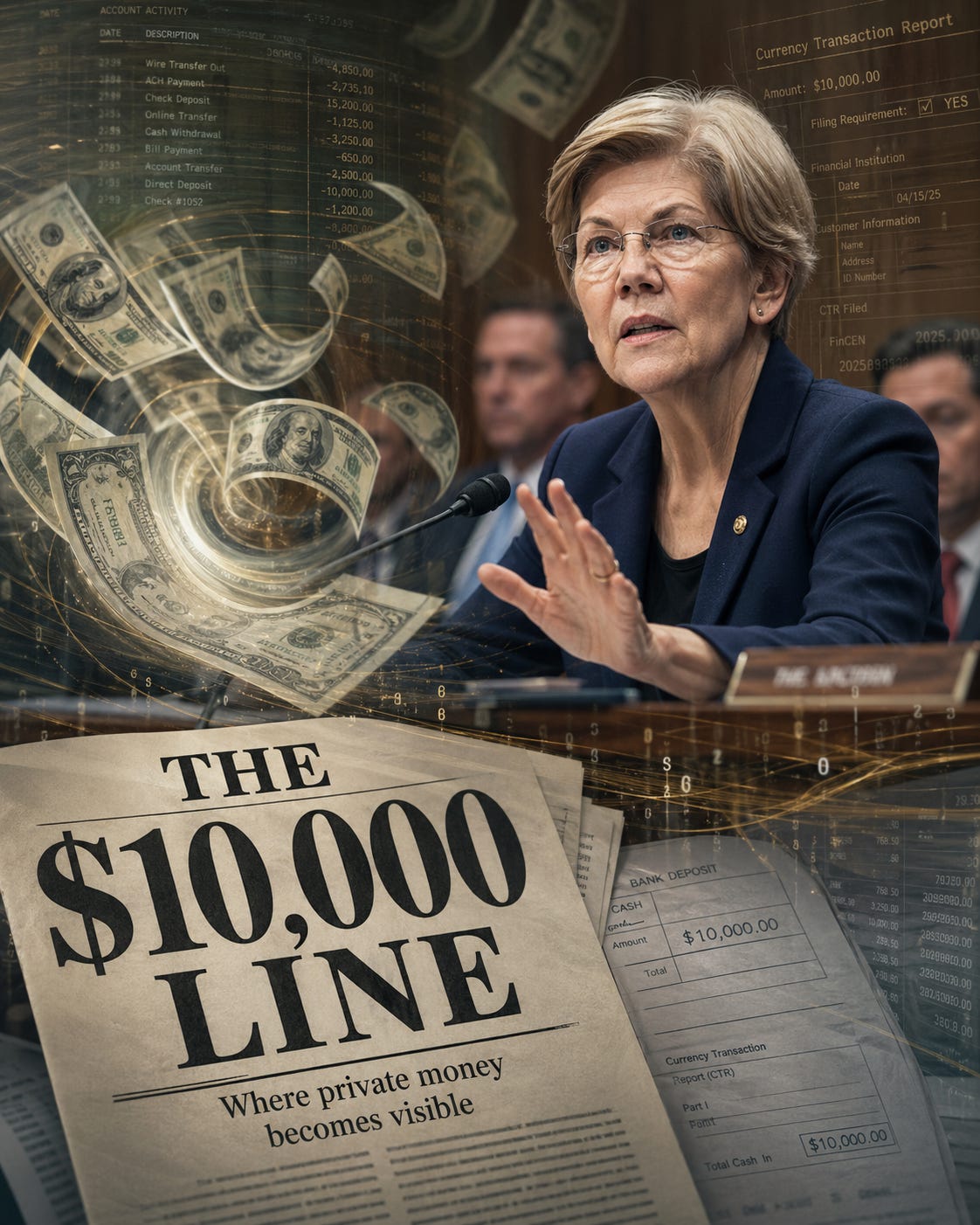
“President Trump just granted private equity billionaires their biggest wish: access to Americans’ retirement savings.”
—Sen. Elizabeth Warren, statement on Trump’s executive order opening 401(k)s to risky assets, August 7, 2025.1
The $10,000 Line
The quiet financial threshold where ordinary money becomes visible to the state
Robert J. Rei, April 25, 2026
Most Americans do not know where their private financial life first becomes formally visible to the state.
They know about taxes. They know about bank accounts. They know that large purchases leave records. They know, vaguely, that the government can investigate fraud, money laundering, organized crime, tax evasion, terrorism financing, and other serious offenses.
But most people do not think carefully about the line itself.
They do not think about the moment when ordinary money movement becomes a formal report.
They do not think about the difference between moving money lawfully and moving money in a way that appears designed to avoid being seen.
They do not think about how a financial rule written for crime detection can become part of a much wider architecture of visibility, classification, suspicion, and control.
That line is often $10,000.
The rule itself is not mysterious. It is simply widely misunderstood. Federal law requires financial institutions to report cash or coin transactions over $10,000 conducted by or on behalf of one person, including multiple cash transactions that add up to more than $10,000 in a single day. These are called Currency Transaction Reports, or CTRs.2
That does not mean a person has committed a crime by depositing or withdrawing more than $10,000 in cash.
That does not mean a person should panic because a report exists.
That does not mean the bank thinks the customer is guilty of anything.
The report is the visibility mechanism.
That is the first civic lesson.
The second lesson is more important: trying to avoid the report can create the problem.
A person who lawfully deposits $12,000 in cash has not necessarily done anything wrong. But a person who breaks that same money into smaller deposits for the purpose of avoiding the reporting rule enters the territory known as structuring. FinCEN describes structuring as breaking up transactions for the purpose of evading Bank Secrecy Act reporting and recordkeeping requirements; its own example includes deposits under $10,000 made to avoid a required currency report.3
This is where ordinary people can get trapped by misunderstanding.
Rumors about the $10,000 line can make lawful people act as if they are hiding something.
A retiree sells a used car. A small-business owner deposits cash receipts. A family member helps an elderly parent move money after a spouse dies. Someone sells tools, jewelry, equipment, collectibles, or household property. Someone withdraws cash because they distrust banks. Someone hears from a neighbor that “anything over $10,000 gets reported” and decides to split the transaction into smaller pieces.
The law may see that not as caution, but as evasion.
That is why the $10,000 line matters.
It is not merely a number.
It is a civic boundary between ordinary private action and state-readable financial behavior.
And once we understand that boundary, we can begin to see the larger system.
The United States does not only govern through police officers, courts, elections, agencies, and legislation. It also governs through records. Financial records are among the most powerful records a modern state can possess because they can reveal relationships, movement, pressure points, dependencies, family support, business activity, property transfers, institutional ties, and private decisions.
Money is not only money.
Money is a map.
A government that can see money can begin to see social structure. It can see who pays whom. It can see who supports whom. It can see which businesses survive. It can see which communities rely on cash. It can see which families move money outside ordinary wage-and-salary channels. It can see which people rely on money services businesses, small banks, credit unions, wire transfers, cashier’s checks, cash deposits, or informal family support.
None of this is automatically sinister.
Anti-money-laundering systems exist for real reasons. Drug trafficking is real. Organized crime is real. Fraud is real. Terrorism financing is real. Tax evasion is real. Sanctions evasion is real. A modern financial system without visibility rules would become a shelter for predation.
But civic danger often begins in the gap between a legitimate tool and an illegitimate use.
The question is not whether financial reporting should exist.
It must exist.
The question is who becomes visible, under what rules, with what safeguards, and under whose political command.
That is where the current moment becomes more serious.
The $10,000 line is the ordinary national threshold people have heard about. But the state can adjust the sensors attached to the financial system. In March 2026, FinCEN issued a Geographic Targeting Order requiring certain money services businesses along the southwest border to report and retain records for currency transactions of $1,000 or more, but not more than $10,000, and to verify the identity of the persons presenting those transactions.
That does not erase the ordinary $10,000 rule.
But it shows the deeper point.
The state can lower visibility thresholds in targeted places. It can attach additional reporting duties to certain businesses. It can define specific geographies as higher-risk zones. It can require more information from some financial corridors while leaving other corridors relatively untouched.
This may be justified in particular cases. The official rationale for the 2026 southwest border order was to combat illicit finance by drug cartels and other illicit actors.4
But the civic principle remains larger than any one order.
Once the sensors exist, political power can decide where to aim them.
That is the part ordinary citizens rarely see.
Some financial rules are broad. Some are targeted. Some apply nationally. Some apply geographically. Some attach to banks. Some attach to money services businesses. Some attach to trades or businesses receiving cash. Some attach to real estate transactions. Some attach to trusts, entities, and beneficial ownership.
Businesses that receive more than $10,000 in cash in a single transaction or related transactions generally must file Form 8300. The IRS says that form provides information to the IRS and FinCEN for efforts against money laundering and related crimes, and it must generally be filed within 15 days after the cash transaction occurs.5
FinCEN’s residential real estate reporting framework adds another layer of visibility for certain non-financed transfers of residential real property to legal entities or trusts. FinCEN’s own FAQ states that a Real Estate Report must be filed when residential real property is transferred, the transfer is non-financed, the property is transferred to a transferee entity or transferee trust, and no exception applies.6
This is the pattern to watch.
The state does not need to watch everything in the same way.
It can raise visibility in one place, lower visibility in another, reduce compliance burdens for some actors, intensify reporting for others, and call the entire arrangement risk-based enforcement.
Sometimes that may be prudent.
Sometimes it may be dangerous.
The danger is not only that criminals are watched. The danger is that lawful populations can be made differentially visible based on geography, class, age, migration status, political framing, banking access, cash reliance, property form, or administrative suspicion.
This matters especially for older Americans.
Retirees often move through financial life differently than younger workers. They may sell property. They may withdraw cash. They may help adult children. They may consolidate accounts. They may downsize. They may pay for repairs. They may enter assisted living. They may become targets of scams. They may distrust digital finance. They may use bank branches more often. They may act out of habit, fear, or advice from peers rather than from legal knowledge.
That makes them vulnerable not because they are criminals, but because they are exposed to a system they may not understand.
A society that does not teach people how financial visibility works leaves them dependent on rumor.
Rumor says: never deposit more than $10,000.
Civic knowledge says: lawful money can be deposited, but do not break up transactions to avoid reporting.
Rumor says: a report means you are in trouble.
Civic knowledge says: a report is a record, not a conviction.
Rumor says: only criminals need to worry.
Civic knowledge says: even innocent people need to understand the systems that make their private lives administratively legible.
This is not legal advice. It is civic education.
And civic education matters because financial control rarely begins with a dramatic seizure. It begins with classification. It begins with reporting. It begins with visibility. It begins with the quiet conversion of private conduct into administrative data.
That data may sit unused.
It may support legitimate investigations.
It may help identify crime.
It may protect the financial system.
But under different political conditions, the same machinery can become something else.
A captured government does not need to seize every bank account. It only needs to control the rules by which money becomes visible, suspicious, movable, frozen, favored, burdened, or politically useful.
That is why the $10,000 line belongs in a much larger discussion.
It belongs beside Treasury payment systems.
It belongs beside IRS enforcement discretion.
It belongs beside bank regulation.
It belongs beside sanctions.
It belongs beside retirement accounts.
It belongs beside private credit.
It belongs beside real estate.
It belongs beside digital assets.
It belongs beside every modern system through which money is recorded, routed, watched, delayed, privileged, punished, or redirected.
The $10,000 line is not the whole system.
It is the doorway into the system.
Before a regime controls the reservoirs, it learns how to see the streams.
And before citizens can defend themselves against financial control, they must understand the first points of contact.
A republic cannot survive on innocence alone. Innocence has to be paired with knowledge. People need to know when the state is merely keeping a record, when the state is investigating a crime, when a private institution is complying with a rule, and when political power is trying to turn ordinary life into a field of suspicion.
That is the difference between panic and clarity.
It is also the difference between a population that can be managed by rumor and a citizenry that can read the machinery around it.
The $10,000 line is not where liberty ends.
It is where financial legibility begins.
And a free people cannot afford to misunderstand the quiet thresholds where private life becomes administratively visible.
The $10,000 line is only the doorway. In the next essay, we move from the small streams of ordinary financial visibility to the great reservoir of American retirement savings. President Trump’s executive order opening 401(k) plans to alternative assets has already drawn a sharp warning from Senator Elizabeth Warren, who called it a gift to private equity billionaires seeking access to Americans’ retirement accounts. That is where this inquiry goes next: from the rules that make money visible to the policies that decide where that money can be routed.
In common cause,
Robert J. Rei, April 25, 2026
Statement by Senator Warren on President Trump’s Executive Order Opening Up Americans’ 401(k)s to Risky Assets, August 07, 2025, U.S. Senator Elizabeth Warren (D-Mass.), Washington, DC, https://www.banking.senate.gov/newsroom/minority/statement-by-senator-warren-on-president-trumps-executive-order-opening-up-americans-401ks-to-risky-assets
Notice to Customers: A CTR Reference Guide, Financial Crimes Enforcement Network (FINCEN), US Treasury Department, https://www.fincen.gov/system/files/shared/CTRPamphlet.pdf
Suspicious Activity Reporting (Structuring), FinCEN Ruling 2005-6, Suspicious Activity Reporting (Structuring), Issued Date, July 15, 2005, Financial Crimes Enforcement Network (FINCEN), US Treasury Department, https://www.fincen.gov/resources/statutes-regulations/administrative-rulings/suspicious-activity-reporting-structuring
Geographic Targeting Order Imposing Recordkeeping and Reporting Requirements on Certain Money Services Businesses Along the Southwest Border, A Rule by the Financial Crimes Enforcement Network on 03/10/2026, Federal Register, National Archives and Records Administration (NARA), and the U.S. Government Publishing Office (GPO), https://www.federalregister.gov/reader-aids/government-policy-and-ofr-procedures/about-this-site
Form 8300 and reporting cash payments of over $10,000, Internal Revenue Service (IRS), https://www.irs.gov/businesses/small-businesses-self-employed/form-8300-and-reporting-cash-payments-of-over-10000
Residential Real Estate Frequently Asked Questions, Financial Crimes Enforcement Network (FinCEN), US Treasury Department, https://www.fincen.gov/rre-faqs
Excellent Article
Do they teach civics in high school anymore?